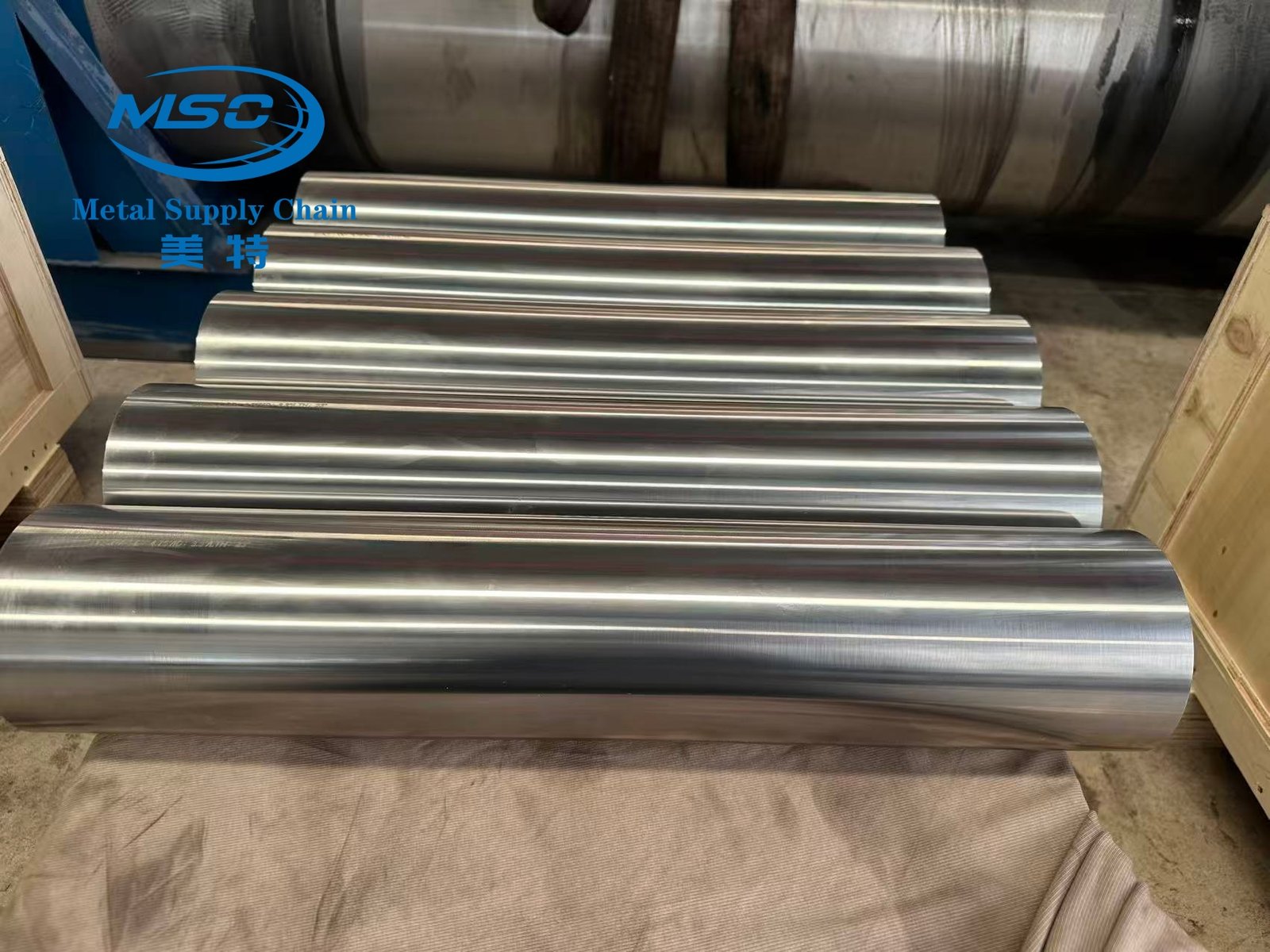
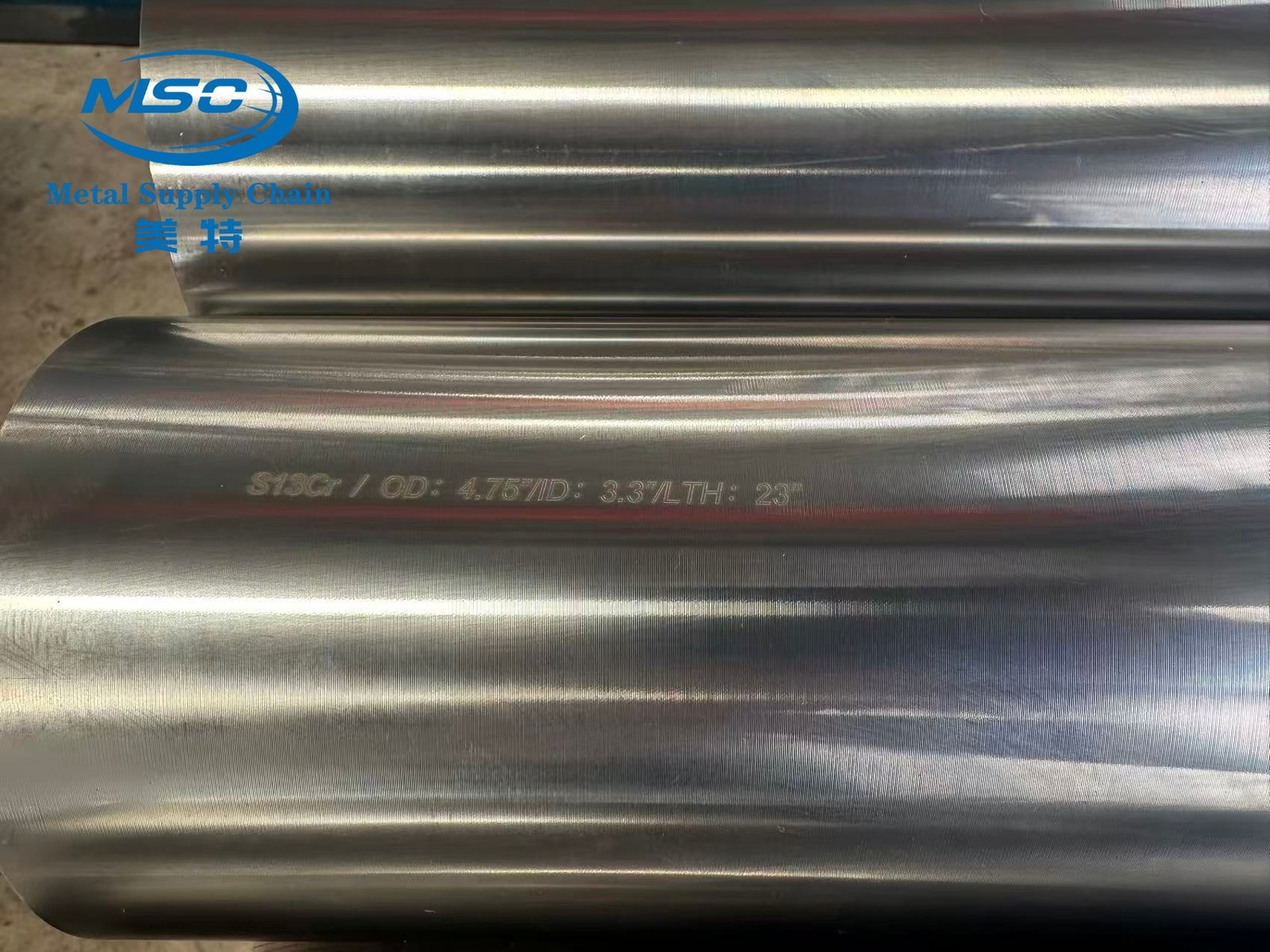
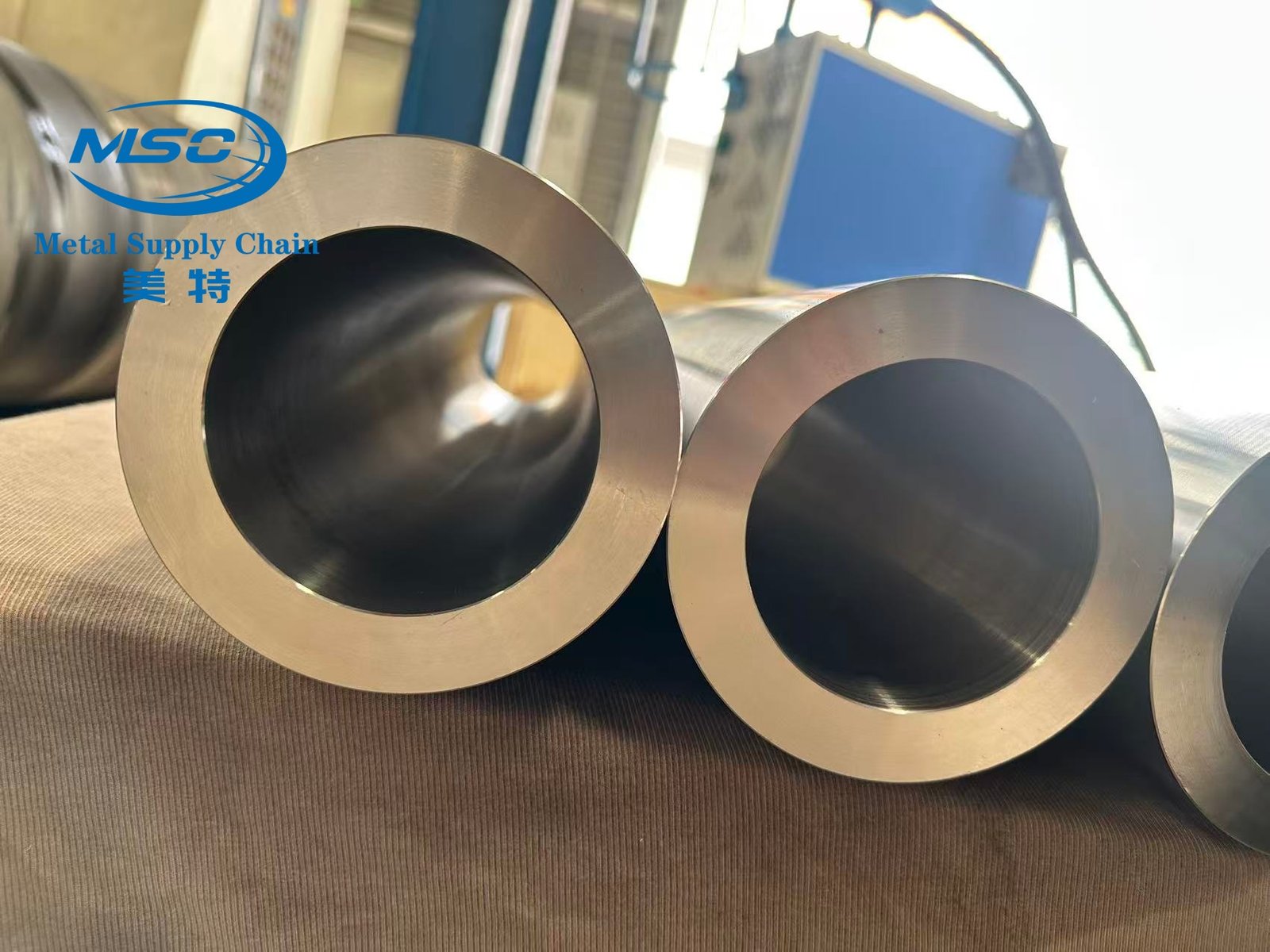
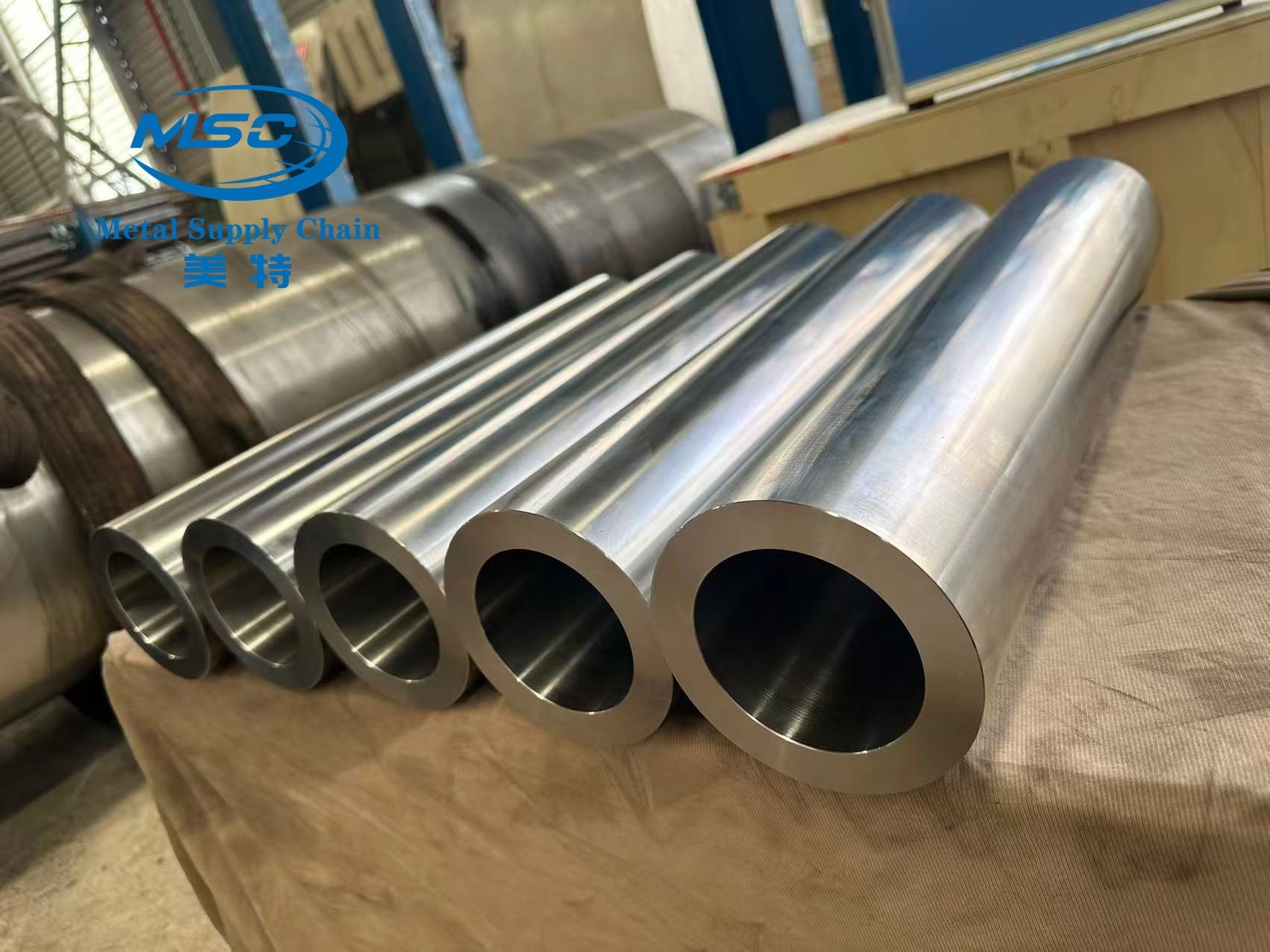
Super 13Cr (UNS S41425 / S41426) · ISO 13680 Group 2
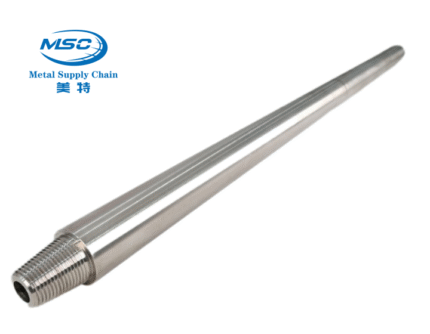
Super 13Cr (ISO 13680 Group 2, UNS S41426 and UNS S41425) is a low-carbon martensitic stainless steel seamless pipe engineered for downhole oil country tubular goods. Featuring 11.5–13.5% chromium with nickel and molybdenum additions, this corrosion-resistant alloy provides high yield strength and superior resistance to wet carbon dioxide and mild sour environments, outperforming standard API 13Cr in demanding oil and gas extraction applications.
Super 13Cr (ISO 13680 Group 2, UNS S41426 and UNS S41425) is a low-carbon martensitic stainless steel seamless pipe engineered for downhole oil country tubular goods. Featuring 11.5–13.5% chromium with nickel and molybdenum additions, this corrosion-resistant alloy provides high yield strength and superior resistance to wet carbon dioxide and mild sour environments, outperforming standard API…
Super 13Cr (UNS S41425 / S41426) · ISO 13680 Group 2
MSC technical data
Super 13Cr
ALL
Product Overview
Super 13Cr (ISO 13680 Group 2, UNS S41426 and UNS S41425) is a low-carbon martensitic stainless steel seamless pipe engineered for downhole oil country tubular goods. Featuring 11.5–13.5% chromium with nickel and molybdenum additions, this corrosion-resistant alloy provides high yield strength and superior resistance to wet carbon dioxide and mild sour environments, outperforming standard API 13Cr in demanding oil and gas extraction applications.
Similar Designations
Similar Designations and Manufacturer Grades
Country / Region
System / Standard / Manufacturer
Designation
Designation Type
Relationship
Applicable Scope
Source
Global / Luxembourg
Tenaris
TN 13SS / TN 13S
Manufacturer Grade
Manufacturer Grade
Proprietary Super 13Cr seamless casing and tubing
[S4]
Japan
Nippon Steel
SM13CRM / SM13CRS
Manufacturer Grade
Manufacturer Grade
Proprietary Super 13Cr seamless casing and tubing
[S5]
Global
Commercial Oilfield Terminology
Standard 13Cr (API 5CT L80-13Cr / UNS S42000)
Commercial Alias
Similar
Standard 0.15–0.22% C martensitic stainless steel (not Super 13Cr)
[S1], [S2], [S6]
Global
Commercial Oilfield Terminology
Hyper 13Cr / 15Cr / 17Cr
Commercial Alias
Similar
Higher alloyed modified martensitic stainless steels (not ISO Group 2 Category 13-5-2)
Downhole casing, tubing, and subsurface components in sour service
[S3]
Global
Commercial Oilfield Terminology
Super 13Cr
Commercial Alias
Confirmed
Industry-standard term for modified 13Cr alloys with Ni and Mo
[S1], [S4], [S5]
Global / Luxembourg
Tenaris
TN 13SS / TN 13S
Manufacturer Grade
Manufacturer Grade
Proprietary Super 13Cr seamless casing and tubing
[S4]
Japan
Nippon Steel
SM13CRM / SM13CRS
Manufacturer Grade
Manufacturer Grade
Proprietary Super 13Cr seamless casing and tubing
[S5]
Global
Commercial Oilfield Terminology
Standard 13Cr (API 5CT L80-13Cr / UNS S42000)
Commercial Alias
Similar
Standard 0.15–0.22% C martensitic stainless steel (not Super 13Cr)
[S1], [S2], [S6]
Global
Commercial Oilfield Terminology
Hyper 13Cr / 15Cr / 17Cr
Commercial Alias
Similar
Higher alloyed modified martensitic stainless steels (not ISO Group 2 Category 13-5-2)
[S5], [S6]
Chemical Composition
ISO 13680 Group 2 - UNS S41426 (Category 13-5-2) Chemical Composition
C
Si
Mn
P
S
Cr
Ni
Mo
N
≤0.03
≤0.50
0.20-1.00
≤0.020
≤0.005
11.5-13.5
4.5-6.5
1.5-2.5
≤0.05
ISO 13680 Group 2 - UNS S41425 (Category 13-4-1) Chemical Composition
C
Si
Mn
P
S
Cr
Ni
Mo
N
≤0.03
≤0.50
0.20-1.00
≤0.020
≤0.005
11.5-13.5
3.5-5.5
0.5-1.5
≤0.05
Mechanical Properties
Mechanical Properties - Grade 95
Parameter
Value
Unit
Yield Strength (0.2% proof)
655-793
MPa
Tensile Strength
≥ 724
MPa
Through-Wall Hardness
≤ 29
HRC
Charpy V-Notch Impact (Transverse, -10 °C)
≥ 40
J
Charpy V-Notch Impact (Longitudinal, -10 °C)
≥ 60
J
Mechanical Properties - Grade 110
Parameter
Value
Unit
Yield Strength (0.2% proof)
758-896
MPa
Tensile Strength
≥ 793
MPa
Through-Wall Hardness
≤ 32
HRC
Charpy V-Notch Impact (Transverse, -10 °C)
≥ 40
J
Charpy V-Notch Impact (Longitudinal, -10 °C)
≥ 60
J
Physical Properties
Parameter
Value
Unit
Density
7.75
g/cm³
Modulus of Elasticity (20 °C)
200
GPa
Modulus of Elasticity (100 °C)
190
GPa
Thermal Conductivity
21.0
W/(m·K)
Transformation Temperatures
Ac1 (Lower Critical Transformation Temperature): Approximately 650 °C to 670 °C
Heat Treatment
Heat Treatment & Delivery Condition
Super 13Cr OCTG casing and tubing are supplied strictly in the quenched and tempered (QT) condition [S1], [S2]. Full-length austenitizing is conducted between 980 °C and 1050 °C, followed by air or liquid quenching to transform the microstructure into martensite [S1], [S5]. Tempering is executed between 580 °C and 650 °C to achieve the designated strength grade and relieve transformation stresses [S1], [S5]. Tempering temperatures must remain strictly below the Ac1 lower transformation temperature (approximately 650–670 °C) to prevent untempered secondary martensite formation, which degrades sulfide stress cracking resistance [S6].
Heat-Treatment Graphs
Illustrative only
Technical graphs
For illustration only — do not use as design, acceptance, or guaranteed product data. This graph shows a representative engineering trend, not measured product data. Actual values may vary with material condition, heat-treatment parameters, section size, and production route. Contact MSC for product-specific technical data.
Hardenability
Illustrative only
Technical graphs
For illustration only — do not use as design, acceptance, or guaranteed product data. The curve shown is a representative hardenability trend for this material grade. Actual values may vary depending on heat-treatment parameters, austenitizing temperature, grain size, section size, and steelmaking practice. Contact MSC for product-specific technical data.
Dimensions & Tolerances
Parameter
Value
Unit
Outside Diameter (OD) Range
60.32 – 273.05
mm
Wall Thickness Range
4.83 – 22.22
mm
Outside Diameter Tolerance
± 0.75
%
Wall Thickness Tolerance
- 12.5
%
Corrosion & Service
Corrosion & Service Performance
Molybdenum and nickel alloying stabilizes the passive chromium oxide film, suppressing pitting and general corrosion up to 180 °C in sweet oilfield brine [S5], [S6]. Under NACE MR0175 / ISO 15156-3 Table A.18, UNS S41426 is qualified for environments with H2S partial pressure up to 10 kPa at any service temperature, or up to 100 kPa at temperatures ≥ 115 °C, provided maximum hardness limits (29 HRC for Grade 95; 32 HRC for Grade 110) are maintained [S3].
Welding & Machining
Welding & Machining Guidance
OCTG tubing and casing are joined strictly via mechanical threaded connections; field welding of downhole tubular strings is not practiced [S4]. Machining requires rigid CNC tooling, carbide inserts, and copious coolant when threading premium connections to control tool wear and work hardening [S4].
Manufacturing & Supply
Attribute
Details
Manufacturing Process
Seamless hot-worked and full-length heat-treated by quenching and tempering (Q&T); EAF melting followed by AOD/VOD refining for ultra-low carbon (≤ 0.03 wt.%).
Delivery Condition
Quenched and tempered (QT) matching specified strength grades (Grade 95 or Grade 110).
Surface Finish
Free from scale and foreign matter; descaled by pickling or blasting; plain-end for threading or threaded with proprietary premium connections.
Inspection & Quality
Inspection & Quality Assurance
Attribute
Details
Mandatory Testing
Heat/cast chemical analysis, room-temperature tensile testing, through-wall hardness testing, and Charpy V-notch impact testing at -10 °C [S1].
Non-Destructive Examination
100% full-body ultrasonic testing (UT) for longitudinal and transverse defects and wall thickness verification along the entire length [S1], [S2].
Hydrostatic Testing
Hydrostatic pressure testing of each tube length at not less than 80% of minimum specified yield strength pressure [S1].
Key Features & Advantages
Key Performance Features
Feature
Explanation
Enhanced Sweet Corrosion Boundary
Operates reliably in wet CO2 environments up to 160–180 °C, significantly exceeding standard 13Cr limits [S3], [S5].
High Mechanical Strength
Supplied in Grade 95 and Grade 110 to withstand high collapse and burst pressures in deep HPHT wells [S1], [S2].
Mild Sour Service Compliance
Meets ANSI/NACE MR0175 / ISO 15156-3 environmental limits for H2S partial pressures up to 10 kPa (or 100 kPa at ≥ 115 °C) [S3].
Sub-Zero Toughness
Guarantees transverse impact energy ≥ 40 J at -10 °C via quenched and tempered martensitic microstructure [S1].
Applications
Primary Oilfield Applications
Application
Explanation
Downhole Production Tubing
Deep, high-pressure production tubing strings producing wet CO2 gas and condensates [S1], [S4].
Production Casing
Production casing and tie-back liners in corrosive offshore and subsea oilfields [S3], [S4].
Gas Injection Strings
Gas-injection and artificial lift strings requiring corrosion resistance without high-cost nickel alloys [S4], [S5].
API / ISO Range 2 (approx. 8.53 m to 9.75 m) and Range 3 (approx. 11.58 m to 12.19 m) [S1], [S2].
End Preparation
Delivered plain-end for threading or threaded with API connections or gas-tight proprietary premium connections [S1], [S4].
Important Notes
Non-Interchangeability & Sour Service Limits: Super 13Cr is strictly limited to mild sour conditions (H2S partial pressure ≤ 10 kPa or up to 100 kPa at ≥ 115 °C) and cannot replace duplex stainless steels or nickel alloys in severe sour gas service [S3]. Furthermore, UNS S41426 and UNS S41425 have distinct chemical and corrosion profiles and must not be averaged or merged [S1], [S2].
Contact / Quotation
For quotations, available forms, dimensions and order-specific technical confirmation, contact MSC.
GCr15 is a high-carbon chromium bearing steel specified under GB/T 18254 and supplied as precision seamless steel pipe or tube under YB/T 4146. It is utilized for rolling-bearing components and other mechanical parts requiring high hardness, superior wear resistance, and robust contact-fatigue strength after proper heat treatment. Chemistry controls, residual limits, and annealed hardness adhere…