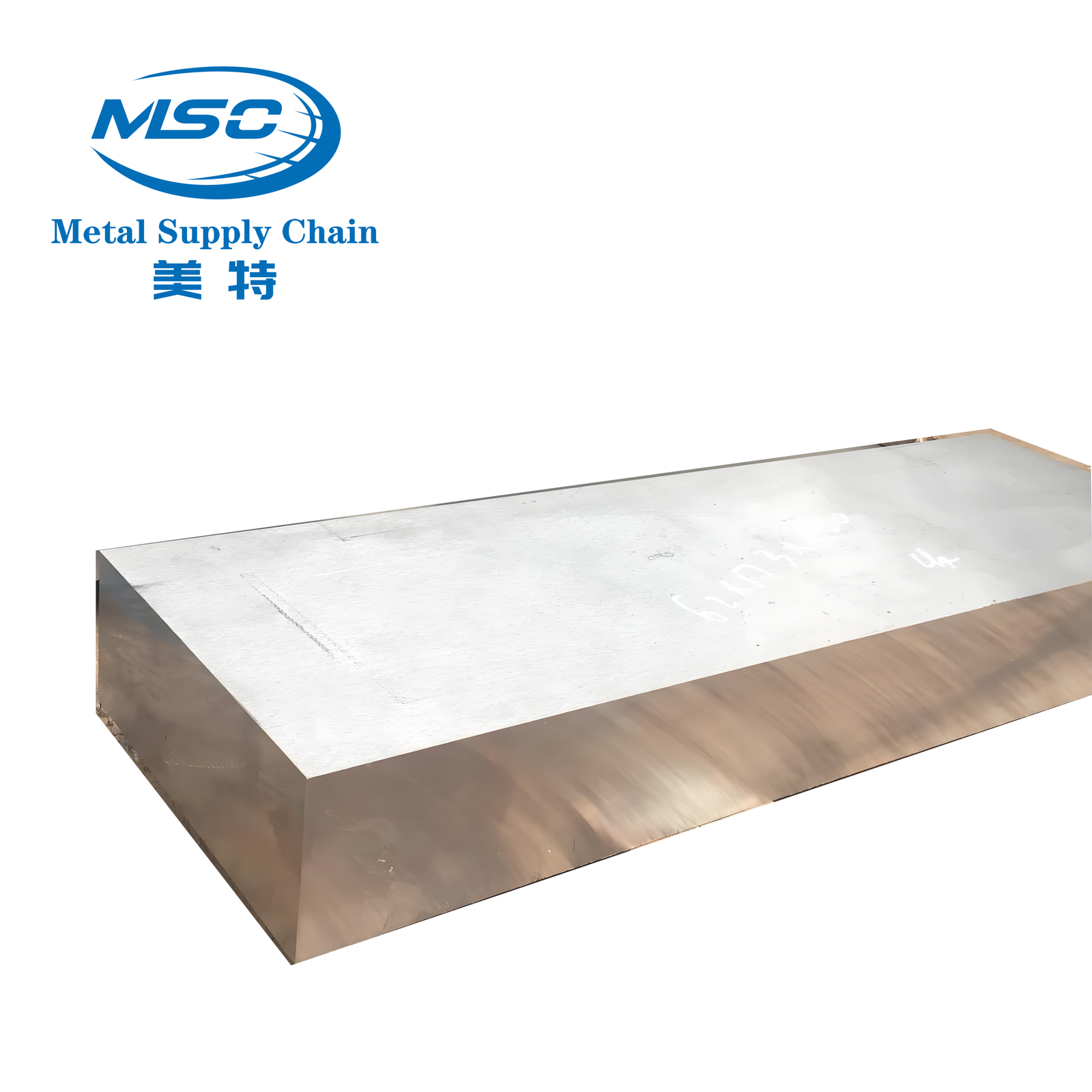
DC53 is a proprietary general-purpose cold-work die and mold steel developed by Daido Steel Co., Ltd. It is an 8 % Cr high-hardness, high-toughness grade designed as an improvement over JIS G4404 SKD11. Typical chemistry includes 0.95 % C, 1.0 % Si, 0.4 % Mn, 8.0 % Cr, 2.0 % Mo and 0.3 % V. After quenching and high-temperature tempering, it reaches 62–63 HRC with superior toughness.
DC53 is a proprietary general-purpose cold-work die and mold steel developed by Daido Steel Co., Ltd. It is an 8 % Cr high-hardness, high-toughness grade designed as an improvement over JIS G4404 SKD11. Typical chemistry includes 0.95 % C, 1.0 % Si, 0.4 % Mn, 8.0 % Cr, 2.0 % Mo and 0.3 % V.…
DC53 is a proprietary general-purpose cold-work die and mold steel developed by Daido Steel Co., Ltd. It is an 8 % Cr high-hardness, high-toughness grade designed as an improvement over JIS G4404 SKD11. Typical chemistry includes 0.95 % C, 1.0 % Si, 0.4 % Mn, 8.0 % Cr, 2.0 % Mo and 0.3 % V. After quenching and high-temperature tempering, it reaches 62–63 HRC with superior toughness.
Similar Designations
Country / Region
System / Standard / Manufacturer
Designation
Designation Type
Relationship
Applicable Scope
Source
Japan
Daido Steel
DC53
Manufacturer Grade
Confirmed
Primary proprietary grade
[S1], [S2]
Japan
JIS G4404
SKD11
National Standard Grade
Similar
Improvement target
[S1], [S2]
International
AISI
D2
National Standard Grade
Similar
Common performance comparison
[S1], [S3]
China (commercial)
GB / commercial
Cr8Mo2SiV
Classification
Similar
Chemistry correspondence
[S4]
Sweden
ASSAB
88
Manufacturer Grade
Similar
Commercial comparison
[S4]
Austria
Böhler
K340
Manufacturer Grade
Similar
Commercial comparison
[S4]
Product Specifications
Parameter
Value
Unit
Typical Chemistry
0.95C-1.0Si-0.4Mn-8.0Cr-2.0Mo-0.3V
wt.%
Common Delivery Condition
Annealed (≈210–225 BHN / ≤255 HB)
BHN / HB
Commercial Product Forms
Round bar, flat bar, plate/block
—
Standards & Designations
Country / Region
System / Standard / Manufacturer
Designation
Designation Type
Relationship
Applicable Scope
Source
Japan
Daido Steel
DC53
Manufacturer Grade
Confirmed
Primary proprietary cold-work die steel
[S1], [S2]
Japan
JIS G4404
SKD11
National Standard Grade
Similar
DC53 developed as improvement over SKD11; not identical
[S1], [S2]
International (common industry)
AISI / ASTM
D2
National Standard Grade
Similar
Frequently compared; DC53 intended as replacement in many cold-work uses
[S1], [S3]
China (commercial)
GB / commercial
Cr8Mo2SiV
Classification
Similar
Chemistry correspondence cited by Chinese suppliers; not formal equivalent standard
[S4]
Sweden (commercial)
ASSAB
88
Manufacturer Grade
Similar
Commonly listed as comparable
[S4]
Austria (commercial)
Böhler
K340
Manufacturer Grade
Similar
Commonly listed as comparable
[S4]
Chemical Composition
Daido Typical Composition
C
Si
Mn
Cr
Mo
V
0.95%
1.0%
0.40%
8.0%
2.0%
0.30%
Mechanical Properties
Parameter
Value
Unit
Annealed hardness
210–225
BHN / HBW
Hardness (high-temperature temper 520–530 °C)
62–63
HRC
Hardness (quenched and tempered range)
60–64
HRC
Physical Properties
Parameter
Value
Unit
Specific gravity / Density
7.76–7.87
g/cm³
Young’s modulus (E)
21,700
kgf/mm²
Modulus of rigidity (G)
8,480
kgf/mm²
Poisson’s ratio
0.28
—
Thermal conductivity (RT)
0.057
cal/cm·sec·°C
Thermal conductivity (400 °C)
0.065
cal/cm·sec·°C
Coefficient of linear thermal expansion (annealed, RT to 100–700 °C)
12.0–13.4
×10&sup-6; /°C
Heat Treatment
Recommended heat treatment parameters and delivery condition:
Parameter
Details
Pre-heat Temperature
800–850 °C prior to austenitization.
Austenitizing / Quenching
1020–1040 °C, cooled via air, oil, or vacuum/gas.
Tempering (Low)
180–200 °C, typically double tempered.
Tempering (High)
500–550 °C (commonly 520–530 °C for 62–63 HRC), double or triple tempered with air cool.
Delivery Condition
Soft annealed to ≤255 HB (typically 210–225 BHN).
Heat-Treatment Graphs
Illustrative only
Technical graphs
For illustration only — do not use as design, acceptance, or guaranteed product data. This graph shows a representative engineering trend, not measured product data. Actual values may vary with material condition, heat-treatment parameters, section size, and production route. Contact MSC for product-specific technical data.
Hardenability
Illustrative only
Technical graphs
For illustration only — do not use as design, acceptance, or guaranteed product data. The curve shown is a representative hardenability trend for this material grade. Actual values may vary depending on heat-treatment parameters, austenitizing temperature, grain size, section size, and steelmaking practice. Contact MSC for product-specific technical data.
Welding & Machining
DC53 features superior machinability and grindability compared to conventional steels like SKD11 and D2, enabling faster machining rates and reduced tool wear. Applying high-temperature tempering reduces residual internal stress, which significantly improves subsequent wire-EDM performance and minimizes the risk of cracking and distortion.
Manufacturing & Supply
Attribute
Details
Production Method
Produced via ladle refinement, vacuum degassing, and controlled forging with secondary refining (DLF) to reduce impurities and refine primary carbides.
Quality Variants
Standard Daido DC53 is supplied, with electro-slag remelted (ESR) versions available from select secondary producers.
Key Features & Advantages
Feature
Advantage
High Hardness
Achieves 62–63 HRC after recommended quenching and high-temperature tempering.
Enhanced Toughness
Offers superior impact toughness and reduced chipping relative to conventional 12% Cr cold-work steels like SKD11/D2.
Machinability
Exhibits superior machinability and grindability, processing up to 40% faster with less tool wear than SKD11.
Wire-EDM Performance
High-temperature tempering minimizes residual stress, reducing cracking and distortion during wire-EDM operations.
Applications
Application Category
Specific Uses
Precision Tooling
Precision press dies, wire-EDM fine-blanking dies, and composite processing dies.
Forming & Forging
Cold-forging dies, deep-drawing dies, thread-rolling dies, and forming dies.
Punching & Cutting
High-speed blanking punches, stainless-sheet punches, shear blades, and cold-heading dies.
Molds & Gauges
Plastic molds and industrial gauges.
Packing & Delivery
Attribute
Details
Commercial Forms
Available in round bar, flat bar, plate, and block configurations.
Delivery Condition
Soft-annealed condition with typical hardness of 210–225 BHN (≤255 HB max).
Important Notes
DC53 is a proprietary manufacturer grade and is not a formal national standard designation under JIS, AISI, EN, or GB. Comparisons to SKD11 and D2 represent performance improvements rather than chemical or standard equivalence. Compositions and properties from secondary producers may vary slightly from original Daido specifications.
Contact / Quotation
For quotations, available forms, dimensions and order-specific technical confirmation, contact MSC.
H12 is a chromium-molybdenum-tungsten hot-work tool steel designated under AISI and specified in ASTM A681 as UNS T20812. It is a general-purpose hot-work grade containing approximately 5 % chromium with additions of molybdenum, tungsten and vanadium, used for dies and tools requiring toughness and resistance to heat checking.
H13 Steel is a chromium-molybdenum-vanadium hot-work tool steel identified as AISI H13 and UNS T20813, and is publicly associated with ASTM A681. It is documented for hot-work tooling applications, while the specific product form, delivery condition, and premium refining route must be defined separately for the material actually supplied.
M2 Steel is a molybdenum-tungsten high-speed tool steel specified under ASTM A600 and designated as AISI M2 (UNS T11302). Although catalogued under cold-work die steel due to secondary applications in punches and forming tools, it serves primarily as a standard high-speed steel. It is commonly supplied in the annealed condition to deliver a balanced combination…